
Best MIDI keyboard controllers
As an Amazon Associate I earn from qualifying purchases. Some links may earn us a commission at no extra cost to you.
A “best” MIDI keyboard is really about key range (how many keys you’ll actually play), plus how well the knobs/faders/pads talk to your DAW. I prioritized controllers that are easy to map, don’t feel like toys, and won’t make you regret the key count a month later.
How I researched
I compared the most relevant spec sheets, maker pages/manuals, and recent hands-on reviews from the last 12–18 months, prioritized key range (number of keys) as the main “do I outgrow it?” factor, checked DAW integration + I/O fit, noted availability/current-gen status, and weighed ownership factors like warranty and physical size.
Top picks
Arturia KeyLab Essential 49 mk3 — Best overall for most home studios
A balanced 49-key controller with enough hands-on control for mixing/instruments without eating your whole desk. Why it wins: strong “everything you need” layout + sensible size/weight for a main controller. It’s also sold in multiple colors and stays compact for a 49.

- New creative features: Scale Mode, Chord Mode, and Arpeggiator, making composition, songwriting, and beat-making more intuitive than ever.
- Custom DAW integration: KeyLab Essential 3 features custom scripts for deeper control over DAWs, including Ableton Live Logic Pro X, FL Studio, and more.
- More versatile presets: The 2000 presets included with Analog Lab V are no longer limited to vintage sounds; users can enjoy unique hybrids, modern synths, orchestral sounds, and more.

Pros
-
49 full-size keys; solid “main keyboard” range
-
Clear size/weight for desk setups (about 31.1″ wide)
-
Good all-round control surface for most DAWs/instruments
Cons
-
No aftertouch (performance limitation)
-
If you play with two hands a lot, 61 keys may suit better
Social proof: See rating & reviews on Amazon.
Trade-offs / who should skip: Skip if you need aftertouch or a premium keybed feel—Arturia’s higher-tier KeyLab line targets that.
Scores: Performance 4/5 · Key range 4/5 · Ease of Use 4/5 · Value 4/5
Novation Launchkey 49 MK4 — Best for Ableton-style workflow and clip launching
If you live in Ableton (or want that workflow), this is the most “DAW-first” 49-key pick here. Why it wins: deep control surface—8 encoders + 9 faders + 16 pads—and strong creative tools built around modern DAW workflows.
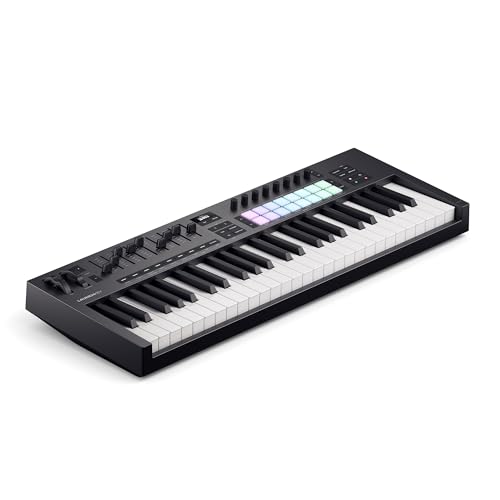
- The Creative Controller: Launchkey is an all-in-one DAW controller with premium keybeds and 16 responsive FSR pads for drumming, clip launching, and more
- Seamless DAW Integration: Launchkey works with all major DAWs, offering intuitive workflows for Ableton Live, Logic, Cubase, Reason, Reaper, FL Studio, and Ardour
- Go Beyond Finger Drumming: Launchkey’s FSR drum pads with polyphonic aftertouch also serve as step sequencers, clip launchers, chord triggers, and more
Pros
-
Hands-on mixing/control: 8 encoders + 9 faders
-
16 pads for drums/clips; strong creative modes for ideas
-
3-year warranty from Novation (for qualifying purchases)
Cons
-
No aftertouch on the keys (expressiveness limit)
-
Some shortcuts are “combo-button” heavy (learning curve)
Social proof: See rating & reviews on Amazon.
Trade-offs / who should skip: Skip if you want the simplest, “just keys + a few knobs” controller—this one shines when you actually use the DAW controls.
Scores: Performance 4/5 · Key range 4/5 · Ease of Use 4/5 · Value 4/5
Nektar Impact LX61 mk3 — Best value 61-key for learning, arranging, and two-hand playing
For many people, 61 keys is the sweet spot before you jump to full-size 88. Why it wins: more key range for real playing, plus a dense control surface (encoders/faders/pads) aimed at DAW integration.
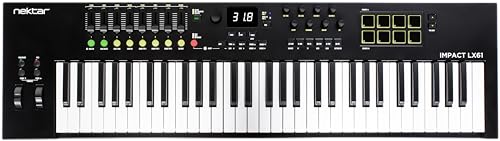
- 61 note velocity sensitive "clean action" keybed.
- Global encoder, 8 x full-resolution encoders, 8 faders, 8 LED buttons, 8 dynamic pads with looper button.
- Scale, Chord and Hold performance features.
Pros
-
61 keys: noticeably better for two-hand parts than 49
-
Built for DAW control: encoders, faders, pads (high control density)
-
Current-gen mk3 line (newer redesign)
Cons
-
Larger footprint than 49-key boards (desk space)
-
Warranty terms from Nektar’s site: couldn’t verify (retailer terms vary)
Social proof: See rating & reviews on Amazon.
Trade-offs / who should skip: Skip if you’re strictly mobile/traveling—61 keys becomes annoying to carry.
Scores: Performance 4/5 · Key range 5/5 · Ease of Use 4/5 · Value 5/5
Akai MPK Mini Plus — Best portable controller with real connectivity
This is the “throw it in a backpack” pick that still feels like a serious idea machine. Why it wins: 37 mini keys + pads + onboard sequencing and extra connectivity (including CV/Gate) for hybrid setups.

- Full Creative Control - A dynamic 37-Key MPK Mini keybed for 3 full octaves of melodic and harmonic performance; Easily connect to your DAW or studio equipment with the USB-powered MIDI Controller
- Advanced Connectivity - Connect to different sound sources with CV/Gate and MIDI I/O; Control modular gear, sound modules, synthesizers, and more to bring new sound sources into your music production
- Native Kontrol Standard (NKS) Integration - Akai Professional and Native Instruments have partnered to bring NKS support to the MPK Controller series, get ready to Kontrol straight from your MPK
Pros
-
37 keys: more playable than 25-key minis for chords/melody
-
Built-in sequencer + broader hardware integration options
-
1-year limited warranty (new units; refurbished differs)
Cons
-
Mini keys aren’t for everyone (try before committing)
-
Not ideal as your only keyboard if you play two-hand parts
Social proof: See rating & reviews on Amazon.
Trade-offs / who should skip: Skip if you’re learning piano technique—full-size keys help. This one excels as a compact production controller.
Scores: Performance 4/5 · Key range 3/5 · Ease of Use 4/5 · Value 4/5
Native Instruments Komplete Kontrol A49 — Best for Komplete/NKS users
If you’re deep into Native Instruments (or lots of NKS-ready plugins), this controller keeps browsing/mapping friction low. Why it wins: tight NKS integration + the A-series workflow (OLED + touch knobs + 4D-style navigation).
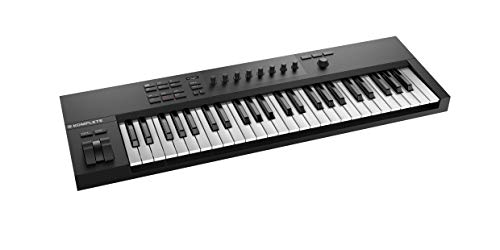
- Smart, streamlined keyboard controller for all your virtual instruments and effects
- Semi-weighted custom NI keybed
- Informative OLED display for at-a-glance navigation
Pros
-
Strong NKS ecosystem fit; quick plugin control
-
49 semi-weighted keys for better playability than minis
-
OLED helps keep you off the mouse
Cons
-
Warranty length from NI directly: couldn’t verify
-
Amazon listing notes “1 year warranty” (may vary by seller/region)
Social proof: See rating & reviews on Amazon.
Trade-offs / who should skip: Skip if you never use NI/NKS plugins—your money may go further with a DAW-centric controller (like Launchkey).
Scores: Performance 4/5 · Key range 4/5 · Ease of Use 4/5 · Value 4/5
Quick compare
-
Best overall: Arturia KeyLab Essential 49 mk3
-
Best for Ableton + hands-on DAW control: Novation Launchkey 49 MK4
-
Best 61-key value: Nektar Impact LX61 mk3
-
Best portable: Akai MPK Mini Plus
-
Best for NI Komplete/NKS: Komplete Kontrol A49
FAQs
Is a 49-key MIDI keyboard enough?
For most producers, yes. 49 keys usually covers common chord/melody work without a huge footprint. If you’re learning piano or writing lots of two-hand parts, 61 keys is more comfortable.
Do I need weighted keys?
Not for production, beats, or synth parts. Weighted keys help if your goal is piano technique and dynamic control. Most controllers here are synth/semi-weighted style (better for general DAW use).
What if I want something super portable?
Pick a mini-key controller with at least 37 keys if possible—Akai’s MPK Mini Plus is a common “portable but still playable” middle ground.
As an Amazon Associate, I earn from qualifying purchases.